
What is fortrust C2002 Speed Controller?
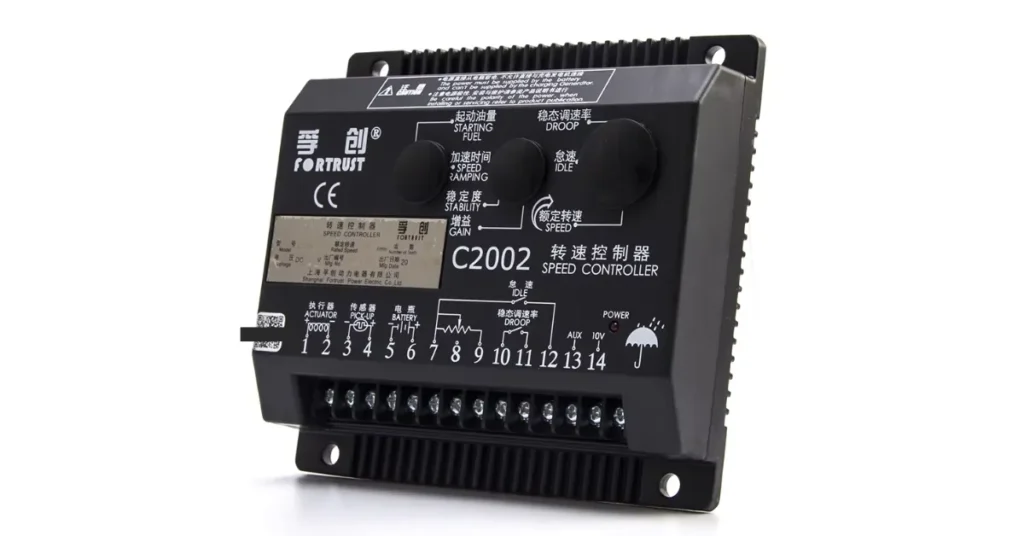
If you’ve ever looked inside a modern diesel generator, you’ve probably noticed a small controller labeled Fortrust C2002. Many people assume it is the main generator controller, but that’s not actually its job.
The Fortrust C2002 is an electronic engine speed governor. Its purpose is to maintain a constant engine speed regardless of changes in electrical load. Since the generator’s output frequency depends directly on engine speed, keeping the RPM stable ensures that the generator continues to produce a stable 50 Hz or 60 Hz output.
In this article, we’ll explore how the C2002 works, the components it requires, and how it keeps a diesel generator running smoothly
What Happens When the Generator Load Changes?
Let’s consider a practical example.
Imagine a diesel generator operating steadily at 1500 RPM while supplying only a small electrical load.
Suddenly, a large electric motor starts, increasing the electrical demand by several kilowatts.
Without a governor, the engine would slow down, causing the generator frequency to fall below 50 Hz.
Instead, the following happens:
- The engine begins to slow.
- The magnetic pickup instantly detects the speed drop.
- The C2002 calculates the error between desired and actual speed.
- It increases the actuator current.
- The actuator moves the fuel rack.
- More fuel enters the engine.
- Engine torque increases.
- The engine returns to 1500 RPM within a fraction of a second.
Most users only notice a very brief dip in frequency before the governor restores normal operation.The Fortrust C2002 is a closed-loop electronic speed controller designed for diesel engines. Unlike mechanical governors that rely on springs and flyweights, the C2002 uses electronic feedback to continuously monitor engine speed and make precise fuel adjustments.
The controller works with three main components:
- A magnetic speed pickup (MPU)
- An electronic fuel actuator
- A 12 V or 24 V DC power supply
Together, these components create a fast and accurate speed control system.
The Basic Working Principle
The C2002 constantly performs three simple tasks:
- Measures the engine speed.
- Compares it with the desired speed.
- Adjusts the fuel supply to correct any difference.
This process repeats hundreds of times every second, allowing the engine to respond almost instantly to changing loads.
Step 1: Measuring Engine Speed
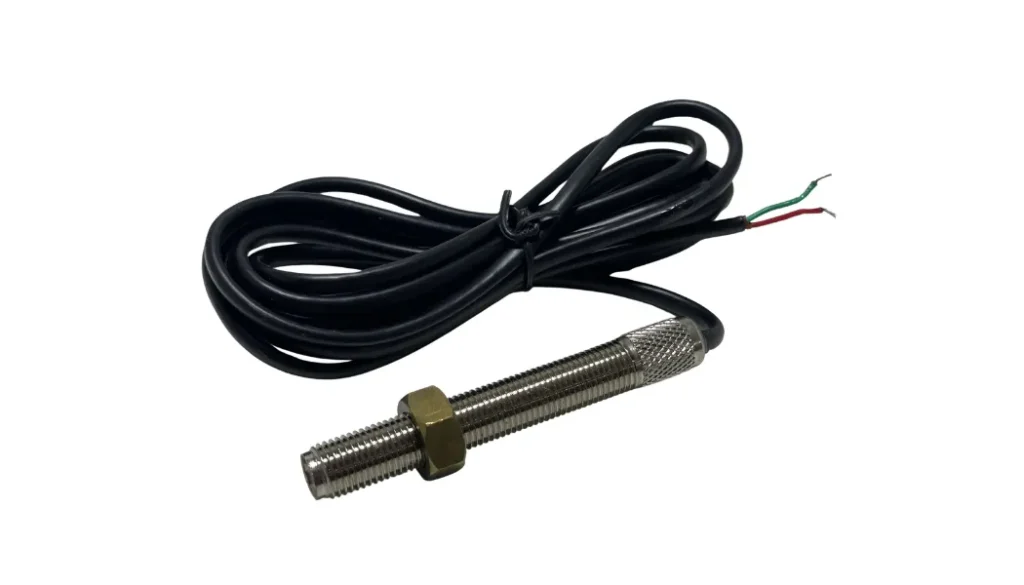
A magnetic pickup sensor is installed close to the flywheel. As the flywheel rotates, each tooth passing the sensor generates an electrical pulse.
The controller counts these pulses to determine engine speed.
For example, if the flywheel has 120 teeth and the engine is running at 1500 RPM, the magnetic pickup produces a signal frequency of:
Frequency = (RPM × Number of Teeth) ÷ 60
For a 120-tooth flywheel:
Frequency = (1500 × 120) ÷ 60 = 3000 Hz
The C2002 continuously monitors this signal to know the exact engine speed.
Step 2: Comparing Actual Speed with the Set Speed
The desired engine speed is adjusted using the SPEED control on the governor.
Typical operating speeds are:
- 1500 RPM for 50 Hz generators
- 1800 RPM for 60 Hz generators
The controller constantly compares:
- Desired RPM
- Actual RPM from the magnetic pickup
If the engine begins slowing down because of increased electrical load, the controller immediately detects the difference.
Step 3: Controlling the Fuel Actuator
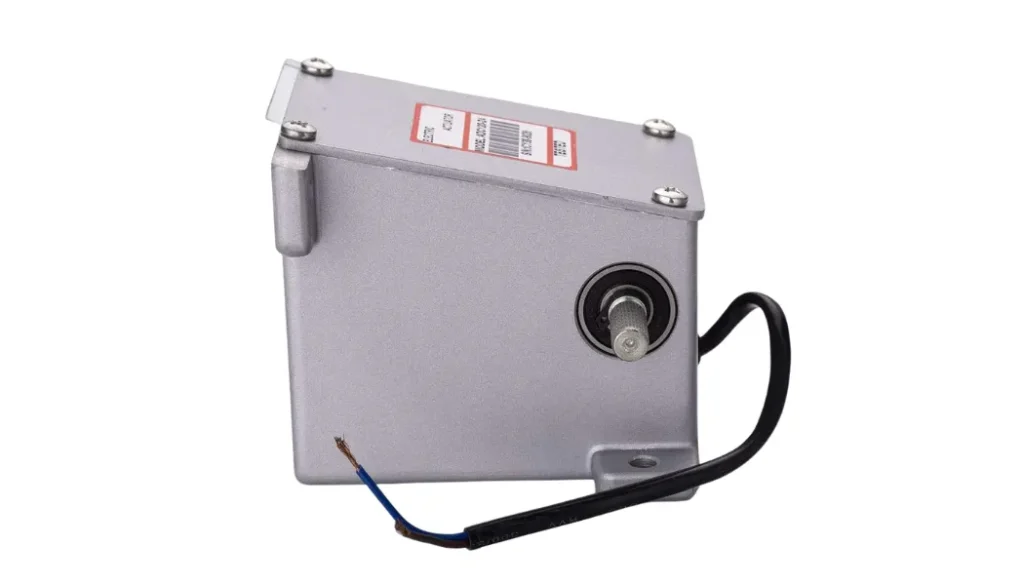
The electronic actuator is connected to the engine’s fuel rack or throttle mechanism.
When the controller detects that the engine speed has dropped, it increases the current supplied to the actuator.
The actuator then moves the fuel rack to inject more fuel into the engine.
More fuel means more engine torque, allowing the engine to recover back to its rated speed.
If the engine begins running too fast, the controller reduces actuator current, decreasing the fuel supply until the speed returns to normal.
This continuous adjustment forms a closed-loop control system.
Important Adjustment Controls
The C2002 includes several adjustment potentiometers that allow technicians to tune engine performance.
SPEED
Sets the rated operating speed of the engine.
IDLE
Adjusts the idle speed when the engine is not under load.
GAIN
Determines how aggressively the governor responds to speed changes.
Higher gain gives faster response but can cause instability if set too high.
STABILITY
Helps eliminate hunting and oscillation after load changes.
Proper adjustment provides smooth operation.
DROOP
Used when multiple generators operate in parallel.
Droop allows generators to share load proportionally.
For single-generator applications, droop is usually disabled.
STARTING FUEL
Controls the amount of fuel delivered during engine starting to improve cold starts.
SPEED RAMP
Adjusts how quickly the engine accelerates from idle to rated speed.
A slower ramp reduces mechanical stress during startup.
Is the C2002 a Complete Generator Controller?
No.
One of the most common misconceptions is that the Fortrust C2002 controls the entire generator.
It does not.
The C2002 only controls engine speed.
Functions such as:
- Automatic engine start and stop
- Generator voltage monitoring
- Oil pressure protection
- Coolant temperature alarms
- Automatic Transfer Switch (ATS) control
- Generator synchronization
- Load sharing
are handled by a separate genset controller, such as those from Deep Sea Electronics (DSE), SmartGen, ComAp, or other dedicated control systems.
Advantages of an Electronic Governor
Compared with traditional mechanical governors, electronic governors offer several advantages:
- Faster response to sudden load changes
- Better frequency stability
- Improved fuel efficiency
- Reduced engine hunting
- More accurate speed control
- Easier adjustment and tuning
- Better performance when generators operate in parallel
These benefits make electronic governors the preferred choice for modern diesel generators.
Final Thoughts
The Fortrust C2002 may appear to be a simple electronic module, but it plays a critical role in maintaining generator performance. By continuously monitoring engine speed through a magnetic pickup and adjusting the fuel actuator in real time, it ensures that the engine maintains a stable RPM under varying loads.
Although it is not responsible for starting the generator, regulating voltage, or protecting the engine, it serves as the “brain” of the engine speed control system. Without a properly tuned governor, a diesel generator would struggle to maintain a stable output frequency whenever the electrical load changes.
Understanding how the C2002 works is essential for generator technicians, engineers, and DIY enthusiasts who want to troubleshoot, tune, or build reliable diesel generator control systems.